Learning support programme
CIS is committed to fostering an inclusive learning environment where the diverse needs of all students are acknowledged and supported. The Learning Support Programme is rooted in the belief that every student can learn and thrive when provided with the right support, tools, and opportunities.
Objectives of the learning support programme
- To ensure that every learner’s individual needs are identified and supported effectively.
- To provide responsive support that enables all learners to thrive academically, socially, and emotionally.
- To create inclusive learning environments that meet the diverse needs of all students.
- To support each student in reaching their full potential through targeted and individualized support.
The Learning Support programme is equipped to support students with the following types of needs, typically falling within the mild to mild/moderate range:
- Dyslexia - difficulty with reading and writing text;
- Dyscalculia - difficulty with mathematical symbols, the steps within a math process, abstract math concepts, memorising formulae, etc.;
- Dysgraphia – handwriting difficulties such as letter formation, layout of letters on a page, and physical tiredness;
- Information processing disorders – impairments in memory, language processing, and sensory-motor integration (such as mild dyspraxia);
- Autism Spectrum Disorder- mild to mild/moderate impairments in social communication and social interaction
- Attention-deficit/hyperactivity disorder (ADD/ADHD)
Additional learning support needs that may be supported depending on the level of need are:
- Physical disabilities
- Self-regulation difficulties
- Other needs that the Learner Success Team determines that the programme can adequately support.
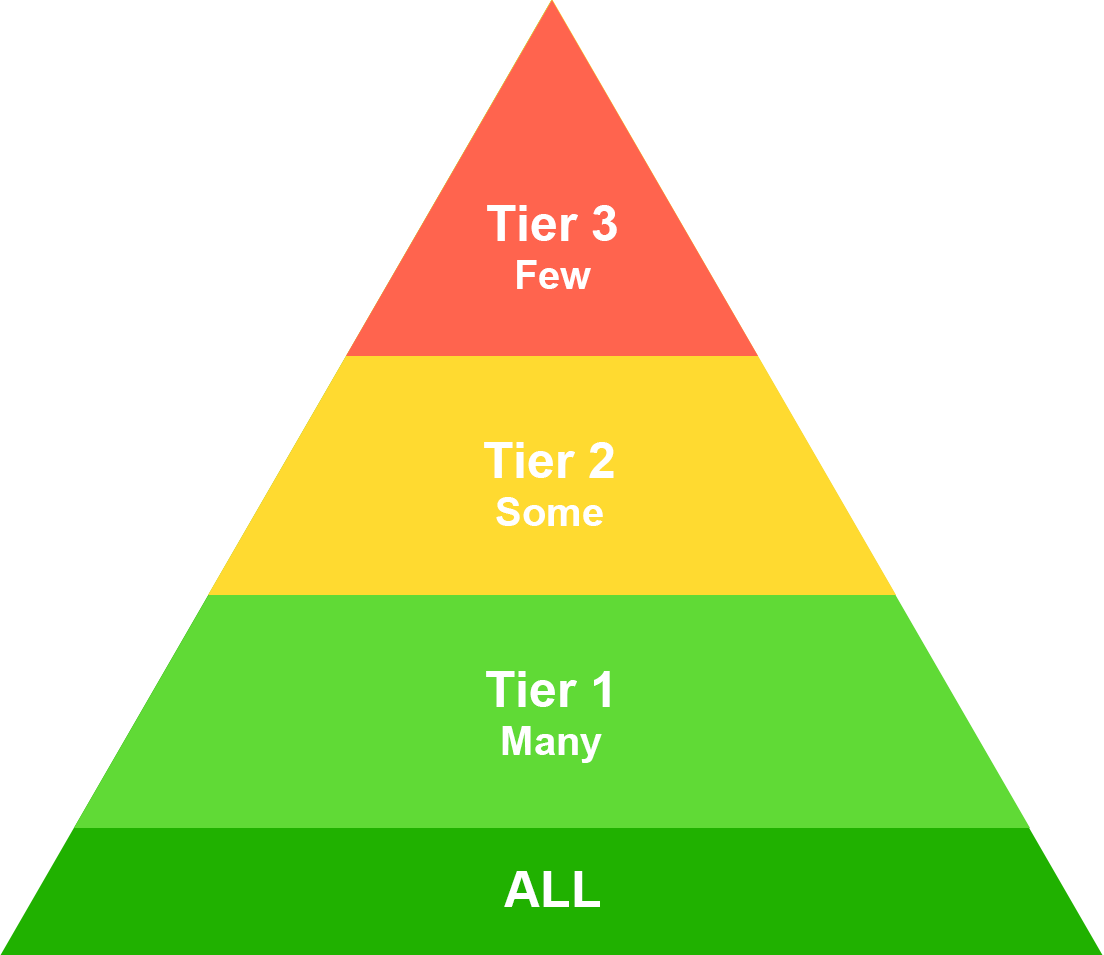
CIS multi-tiered systems of support
Tier 1: Core classroom instruction with embedded accommodations
All students receive high-quality differentiated instruction to meet identified learning targets. To meet these targets, some students require additional instruction or intervention from the classroom teacher. When students are struggling to master proficiency, Tier 1 core classroom instruction is differentiated to scaffold their learning and progressively build their skills. In addition, Tier 1 may include one or more of the following:
- A diagnosis of a learning, cognitive, or social-emotional difference
- Classroom accommodations
- Assessment accommodations
- Conditional or provisional enrollment
- Social/Emotional/Behavioural monitoring
Tier 2: Targeted instruction and intervention *fee-based service
Students who do not meet expected targets and benchmarks through regular classroom instruction and/or Tier 1 accommodations may require additional support from a Learning Support team member. Identification of students in need of supplemental instruction is based on a combination of referrals, assessment data (formal and informal), grades, and teacher observations.
In Early Years and Primary, Tier 2 support is provided for a minimum of 80 minutes per week. In Secondary, it is delivered for at least 160 minutes over an 8-day cycle.
Tier 3: Intensive interventions and comprehensive evaluation *fee-based service
Students who do not meet expected progress despite Tier 2 interventions may be referred for a comprehensive evaluation and considered for Tier 3 Learning Support by the Learner Success Team (LST). In some cases, students may qualify for Tier 3 services without having previously received Tier 2 support, based on their individual learning profile and the nature of their needs.
Tier 3 services are fee-based and are designed to provide individualised, intensive and more frequent intervention. In Early Years and Primary, Tier 3 support is delivered for a minimum of 160 minutes per week. In Secondary, Tier 3 is scheduled as a course within the student’s regular timetable, meeting for four classes over an 8-day cycle.
Tier 3: Frequent, intensive services
Fee-based, Individual Learning Plan, External Evaluation required, 160 minutes direct service/week minimum
Tier 2: Targeted intervention services
Fee-based, Individual Learning Plan, Internal Assessment required, 80 minutes direct service/week minimum
Tier 1: Classroom based
Not fee-based
Classroom & Testing Accommodations
All
High-quality, differentiated classroom instruction for all students, Inclusive practices and flexible strategies to support diverse learners





Canadian International School