
Keeping humans at the centre of AI in schools
By Zachary Walters, Educational Technology Coordinator
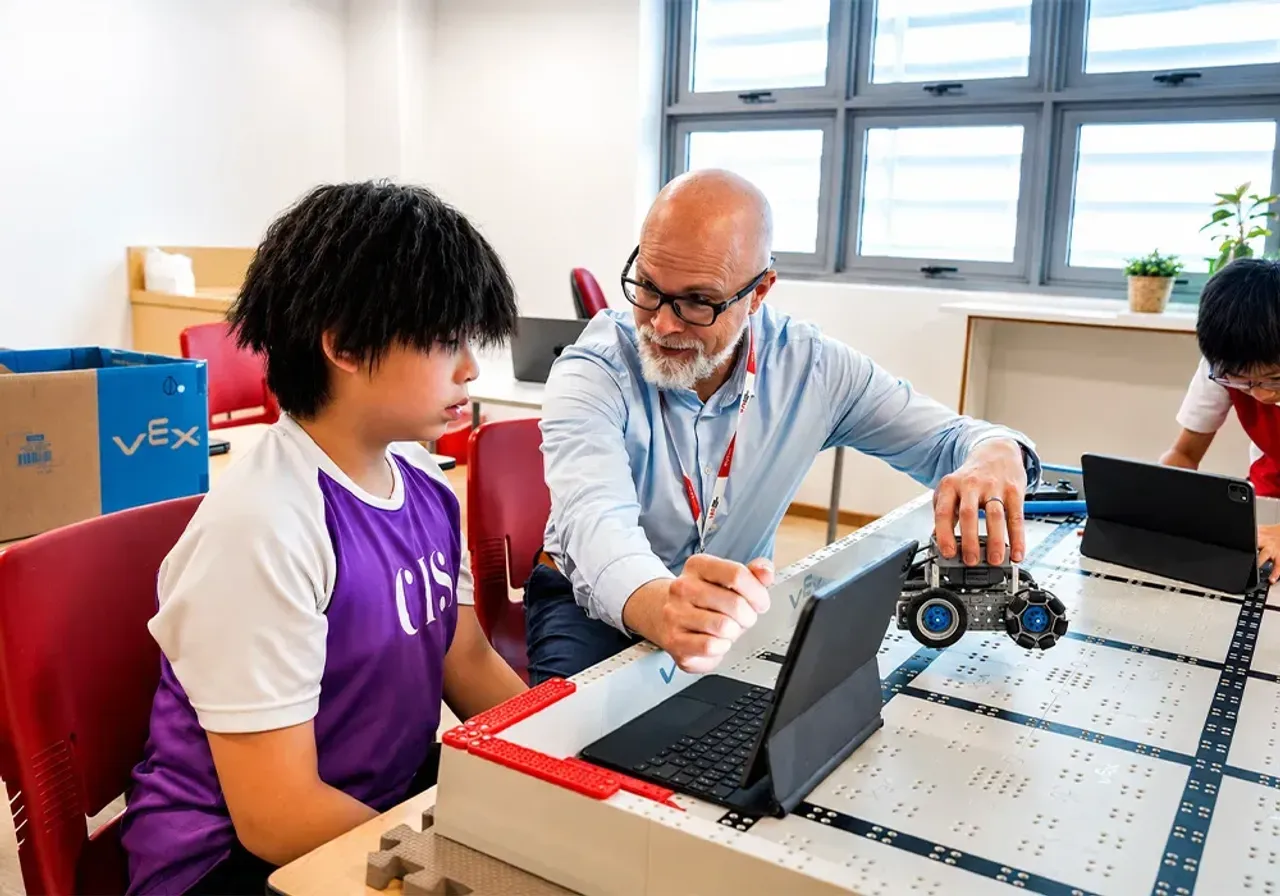
As an EdTech Coordinator at an international IB school in Singapore, I am constantly asked how we are using AI, with the subtle allusion to "automating" our classrooms. My answer is always the same: We are not. We are augmenting the human, not automating the learner.
In the global rush to adopt Language Learning Models (LLMs), we are facing a qualitative shift. We have moved from tools that perform specific tasks, (like calculators), to tools that simulate the entire process of reasoning. The danger is not that AI is too smart; it is that we might become too lazy. If we allow technology to solve the productive struggle that defines student growth, we are not innovating, we are incurring cognitive debt. We are trading the development of a student’s mind for a polished, AI-generated output. That is a trade we refuse to make.
Designing AI use around human learning
To ensure we remain the primary authors of our own intellectual development, our infrastructure is built on the Human-AI-Human (HAIH) Model. This ensures technology serves as a thinking partner, never a substitute for mental labour:
- Human inquiry: Every task begins with independent, reflective goal-setting. No prompts are entered until the student has defined the "why".
- AI scaffolding: AI acts as either a Socratic tutor to increase the depth of cognition or a "noise filter," handling lower-order tasks, (brainstorming, lexical retrieval, data sorting) to free up working memory for higher-order reasoning.
- Human reflection: The process ends with epistemic vigilance. Students must critique, edit, and fact-check the inherent Western bias of AI. If the person is not the final architect, the work has no value.
Framework for using AI with purpose in schools
Intentionality is our safeguard. We have implemented a campus wide AI Use Scale that aligns all staff - both operational and academic - and students. This scale designates specific cognitive actions and provides clear examples of how AI should be used to improve a process rather than replace a skill.
- Teacher Autonomy: Our educators are the pedagogical architects. They have complete autonomy to assign a level on the AI Use Scale to any task or assessment, deciding where the struggle needs to happen and where the AI can provide a scaffold.
- The Developmental Onramp: We believe in a deliberate entry point. Students first access AI in Grade 6 (age 11) using NotebookLM. This source grounded environment teaches them to use AI as a research assistant that sparks curiosity and deepens understanding - not as an answer generator.
Protecting the learning process in the Aage of AI
The science is clear: when AI replaces the process of thinking, cognitive stamina declines. However, when integrated as part of an iterative workflow, it can enhance executive function. We focus on:
- Cognitive stamina: Utilising guardrails that provide hints, not direct answers.
- Metacognition: Questioning the results of an AI inquiry and requiring students to explain how they used AI to arrive at their conclusions.
- Staff wellbeing: Using AI to automate administrative "weights" for staff, returning more time for what matters most: Human-to-human mentorship.
The bottom line: We are not teaching students to use AI; we are teaching them to use their minds in a world where AI exists. If we use AI to replace thinking, we fail our students. If we use it to expand the boundaries of what a human can achieve, we fulfill our mission.
Humans must remain at the center. Period.

Educational Technology Coordinator
Author biography:
Zachary spent his career learning that the most powerful tool we possess isn't a hand tool or a line of code, it’s a mind taught to see. His work is focused on the architecture of thought: moving beyond just "fixing" a situation to developing the systems of thinking required to identify what the true problem is in the first place.
This philosophy was forged in the grit of industrial welding shops, artisanal studios, and factories. In those spaces, he learned that a "maker’s mindset" isn’t just about manual dexterity; it’s about understanding the internal logic of a system. When he moved into human services and advocacy, he realized that the same principles of functional design apply to people- the goal is always to build the frameworks that foster independence and autonomy.
Today, as an educational technology and digital innovation coordinator, he views a school’s entire ecosystem through that same craftsman’s lens. Whether he’s piloting AI strategies or designing STEAM curricula, he sees technology as a medium for wonder. His journey from the visual arts into robotics and leadership is a continuous effort to create the spaces where curiosity can thrive. He’s still a maker at heart; he simply scaled his workbench, dedicated to designing the conditions that inspire learners of all ages to see the world as something they have the power to shape.

Canadian International School