Husky Stories: Student engineer Noah G. builds a Jet Engine
By CIS Communications
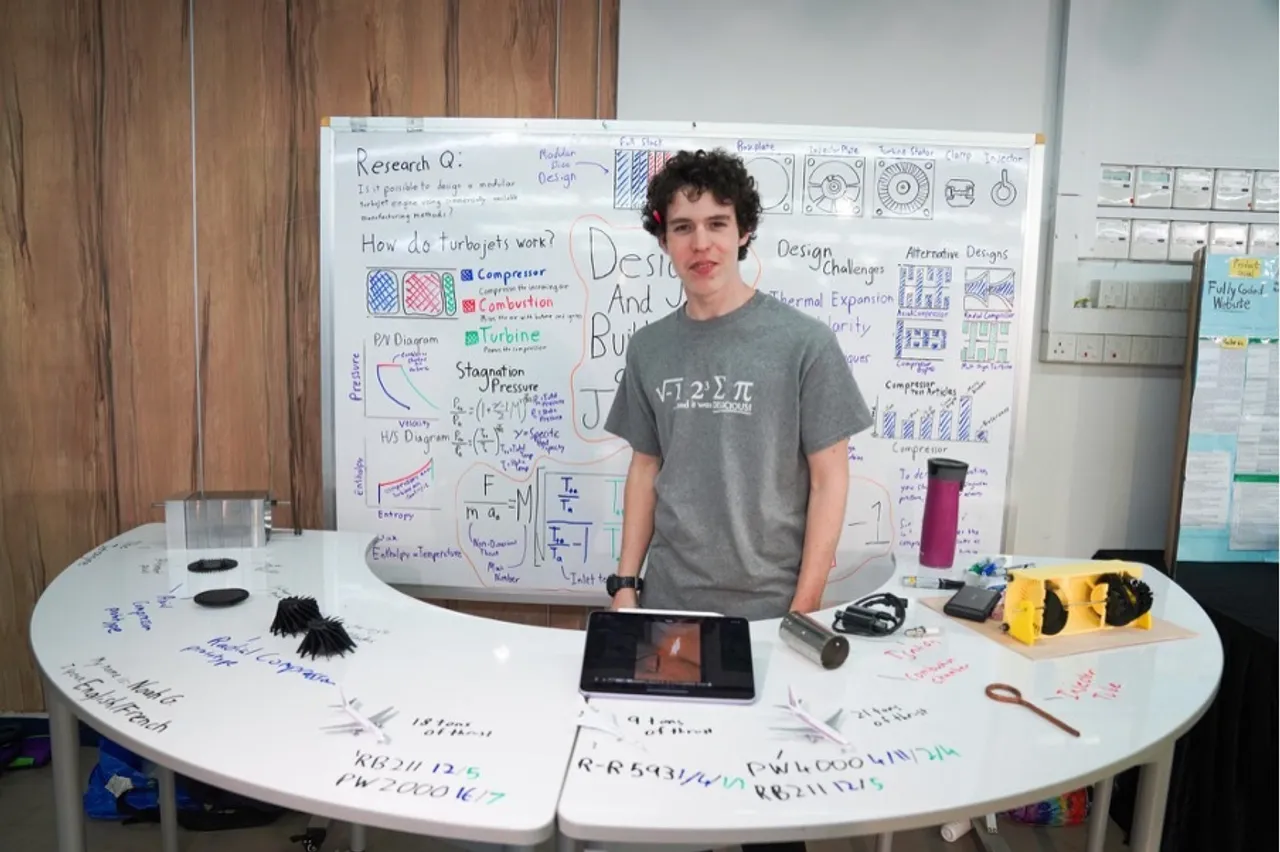
A jet engine is one of the most complex machines humans have ever built. Shrinking it to tabletop size and building a working version is no small task. For one student engineer, it became a year-and-a-half-long experiment in design, physics, and persistence.
Hear from Grade 11 student Noah as he walks us through what sparked the idea, how he built a modular jet engine, and what he’s learned along the way.
What first made you curious about jet engines?
This project all started when I saw a mechanical engineer post online about a jet engine that he had built! He used manufacturing methods that most people don’t have access to, which made me wonder whether I could build a jet engine using only commercially available components.
What were your first steps in turning your idea into a real, working engine?
I started by breaking the project into smaller parts that felt more achievable. Before tackling the main components of the jet engine, I focused on designing the compressor. I modeled all the parts in CAD software and 3D-printed prototypes, testing at least fifteen different compressor designs before settling on a hybrid version that performed well.
I was also fortunate to have guidance from a mechanical engineering professor at the National University of Singapore who specialises in aerospace engineering. He recommended several textbooks and worked closely with me on the compressor design. Having advice from someone with experience designing propulsion systems made a huge difference throughout the project.
What have been the most exciting breakthroughs in your project so far?
The biggest breakthrough was the first time I fired up the engine! At that point, I had spent eight months working without any proof that it would actually function. I turned on the ignition, spun up the startup motor, opened the fuel valve, and flames roared out the back! It was so cool. There were still plenty of issues to solve, but that first successful test was proof that I was on the right track.
What skills have you gained that surprised you along the way?
The project demands many skills such as CAD design, 3D printing, metalworking, and more. I learned a lot of physics, spending days working through the jet engine equations that link variables like pressure, temperature, air velocity, and efficiency. On top of that, I learned experimental techniques such as ways to measure compressor efficiency, airflow, and performance.
But the most surprising skill I gained was science communication. Explaining how a jet engine works, without turning it into a wall of equations, is really hard but documenting the project and sharing it online has really helped me improve.
How has CIS supported your journey?
I’ve received support from many CIS teachers, and I’m so grateful. My mentor, Mr Ocaña supported me from the very beginning. He came to cheer me on during early tests, pushed me to document the project, and helped with filming. From day one, he believed I could do this.
I’d also like to thank Mr Cooperman for letting me use his tools and equipment, Helmi for helping machine the combustion chamber, and Mr Fletcher and Mr Wheeler for helping me understand the equations and derivations for the physics behind a jet engine!
Noah, your hard work and passion continue to inspire us all. We’re so proud of you!

Canadian International School