Copying is not the opposite of creativity. It is where it begins
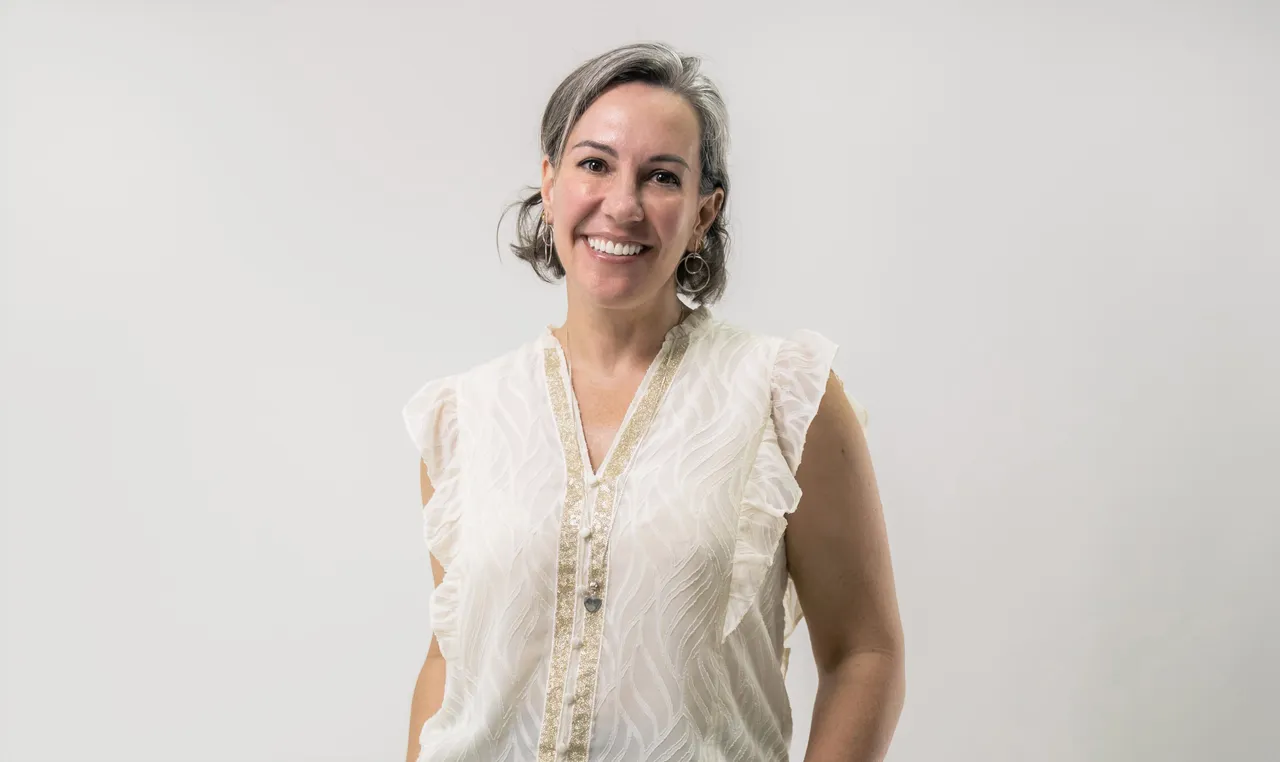
By Candace Granfelt, Secondary Arts Teacher
It started with a question...a small question that led me to think more deeply about how I think about learning.
A grade 11, Visual Arts Diploma student, holding paintbrush and looking thoughtful, asked: “So... I just copy it?”
I smiled. I understood the curiosity and anxiety behind her words. Yes, technically, that was the task. But hidden in that question was something much bigger. It is something I have spent years thinking about and still have not fully resolved. Howdo we learn from others while finding our original voice? When does the copying become authorship?
We live in a world that celebrates originality and disruption, that treats creativity as something that springs from nowhere, that is suspicious of imitation. My students absorb that message. Sometimes I absorb it too, and have to remind myself that the most creative people I know are also the most devoted students of what came before them. Rick Rubin (2023) writes about creativity as "listening for what wants to be created." I love that, because it reframes the whole creative experience . It is not about control or sudden inspiration. It is about attention and response. And attention is something you practise. Emulation is one of the best ways I know to practise it.
When a student 'copies' an artist — what we call emulation — they are doing more than reproducing a creative strategy. Emulation is not passive. It is a way of listening with our hands, our eyes, and our attention: stepping into another person's way of seeing, entering a conversation with the artist's techniques, and exploring how that artist makes sense of their world through art.
In our art studio, emulation becomes a conversation. I tell my students: “You are not just copying. You are learning how to have a conversation with an expert.” You listen deeply to their ideas. That is analysis. You learn to speak their visual language. That is emulation. Then you bring your own voice into the exchange. That is synthesis.
The best teacher moments are when you witness something shifting with a student. It happens quietly: a subtle choice that feels true, sometimes even a mistake. Suddenly, it is theirs. No longer a copy, but a conversation between their visual language and influence. This came to life when a Diploma Year 2 Visual Art student spent the summer of 2025, carefully copying photographs of portraits, again and again, for eight hours each day. He studied every contour and shadow, repeating the process patiently, over and over. At first, it seemed to him like simple technical practice, but something deeper was happening.
He was training his eye and building his visual vocabulary. Over time, his artistic confidence grew, alongside his technical skills. Now, instead of relying on found images, he takes his own photographic portraits, directing light and framing compositions with intention. Then he draws from his photographs, bringing his personal perspective and visual language to every portrait. What began as imitation gradually became a conversation between his creative vision, artistic language and his technical mastery. His story is not exceptional; it is the creative thinking pattern.
I believe the iterative cycle of “copying” nurtures creative cognitive flexibility. In our art studio ideas circulate continuously between students, teachers, historical artists, contemporary culture, and personal experience. Observation leads to experimentation, experimentation leads to reflection, and reflection reshapes how students see their next attempt. Systems thinkers, Peter Senge (1990), and Donella Meadows (2008), emphasise how moving through this cycle is about noticing patterns, relationships, and feedback loops rather than isolated ideas.
Every artwork becomes a cycle of noticing, experimenting, reflecting, and trying again. That is exactly what I see art students doing, mark after mark; brushstroke by brushstroke in our art studio. The theory, while true, can get in the way of a simpler truth: copying is a practice of presence. It is holding your attention steady in the middle of something unfamiliar, resisting the urge to skip ahead to the part where you are original. That is harder than it sounds. And I don't always get it right as a teacher either.
There are days when I watch a student labouring over an emulation exercise and I feel the pull to intervene too early; to point out what they are really learning, to name the cognitive process, to make it tidy. I have learned, slowly, that the most important thing I can do in those moments is nothing. Let the quiet work do what quiet work does.
This is important for me to do because creativity only grows where curiosity meets persistence and courage. Courage is often slow and met with productive struggle. Bill Lucas and Ellen Spencer (2017) call this 'tolerating uncertainty'. It is the disposition to stick with difficulty and trust the messy process. In our studio, that is what copying helps teach: trusting the process in the midst of the unfamiliar, turning imitation into authentic voice.
Why is this important for our student’s future? Creative learning is meta-thinking; learning how to learn, and it reaches far beyond the art studio. We are living in what some call the Remix Economy. In most fields experts study what exists, to understand how they function. Then they remix these insights to create something fresh and meaningful; value is created not only through original ideas, but through the reinterpretation and recombination of existing ones. McKinsey & Company’s report (2021), highlights that as AI takes over routine tasks, skills like cognitive flexibility, creativity and synthesising become critical. When my students reinterpret an artist’s style, they are practising the same cognitive move as the engineer who studies an existing design before innovating on it, or the writer who reads voraciously, before finding their own sentence.
So when a student asks “Do I just copy it?”, I no longer correct them. I smile and say, “Yes. Start there. Copy it carefully. And notice what happens as you do.”
What happens, if they stay with it, is that the copy stops being a copy. Somewhere along the way, what was borrowed becomes unmistakably theirs. That is where creativity begins, and I step back, and let the artist go.
Bio
Candace Granfelt is a Visual Arts and Theory of Knowledge educator with over twenty years of experience across Special Needs Education in London and three leading international schools in Singapore. A practising IB examiner in both Visual Arts and Theory of Knowledge, she currently teaches DP, MYP and AP Visual Arts and TOK. Candace is a qualified Cognitive Coach and Instructional Coach whose work centres on concept-driven, inquiry-based learning and the cultivation of creative thinking. Her practice focuses on learner agency, visible thinking and psychologically safe learning environments that enable students to take intellectual and creative risks. She is particularly passionate about curriculum innovation, interdisciplinary learning and the intersection of creativity, coaching and AI-informed educational practice. Alongside her teaching, Candace facilitates professional learning for educators, supporting reflective practice, collective efficacy and more human-centred approaches to teaching and learning.

Canadian International School